

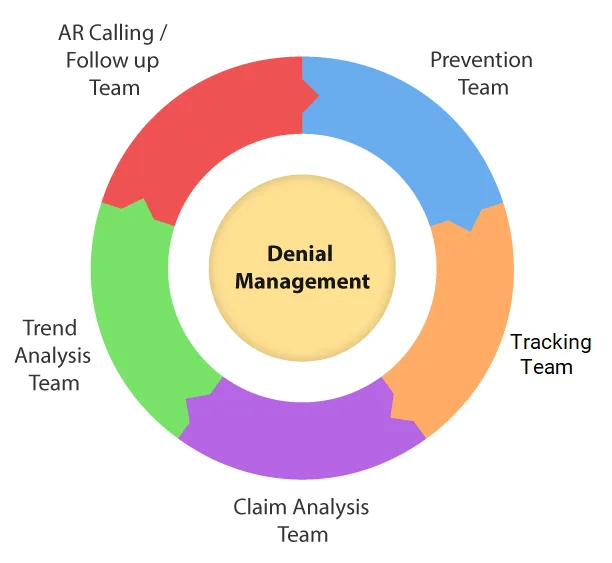
The denial management process in medical billing has five steps: identify and log every denial, sort denials by cause, fix and resubmit or appeal them before the deadline, track the outcome, and prevent the next one by fixing the root cause. This guide walks through each step, the numbers to track and how to stop denials before they happen. If your team has no time to run it, our denial management services can take it over.
A denied claim is a claim you have already earned that the payer has refused to pay as submitted. Every denial costs staff time, delays payment and, if nobody follows up before the deadline, can become a write-off. Denial management is the routine of finding denials, fixing or appealing them, and, most importantly, removing the causes so they stop coming back. This guide explains the process step by step, with the numbers to track and when it makes sense to get help. If you would like an expert review of your denials, you can talk to our team.
Denials and rejections are not the same
A rejection happens before the payer adjudicates the claim, usually because of a format or data error. It can be corrected and resubmitted. A denial happens after the payer has reviewed the claim and decided not to pay it, in whole or in part. A denial usually has to be corrected or appealed within the payer’s deadline. Track both, because they have different fixes. For more on rejections, see why rejection rates rise.
Why claims are denied
Most denials come from a short list of causes, and most of them are preventable:
- Eligibility problems: coverage that has lapsed, changed or belongs to a different payer.
- Missing prior authorization: a service performed without the approval the payer requires.
- Coding errors: wrong, outdated or unsupported codes, missing modifiers and invalid code pairs.
- Documentation gaps: notes that do not support the medical necessity of the service.
- Timely filing: a claim sent after the payer’s filing limit.
- Duplicate claims and coordination of benefits: the same claim sent twice, or the wrong payer billed first.
Our guide to the top reasons for claim denials goes through more causes, and the denial codes and reasons guide explains how to read the codes. Common ones have their own articles, such as the CO 16 denial code, the CO23 denial code and the 197 denial code.
Types of denials
- Soft denials are temporary. The claim can be corrected, supported with records or resubmitted.
- Hard denials are final for that claim, often because of a coverage or benefit limit. They may only be appealable.
Some denials never show up as a clear message. See silent claim denials to learn how to find claims that were never paid and never answered.
The denial management process
- Identify and log every denial. Work from your remittance advice, clearinghouse reports and payer portals, and record the claim, payer, date and reason code.
- Sort by cause. Group denials by reason code, payer, provider and service, so you can see patterns instead of single claims.
- Fix or appeal. Correct and resubmit when the error is yours. Appeal when the denial is wrong, with the records that support the claim.
- Track the outcome. Note whether each claim was paid, partly paid or written off, and how long it took.
- Prevent the next one. Take the biggest pattern and fix it at the source: registration, authorization, coding or documentation.
Appeal basics
Appeal deadlines vary by payer, plan and type of denial, so check each contract and put the deadline on your tracking sheet from the day the denial arrives. Keep a template for common appeals, attach the records that support the claim, state clearly why the payer’s decision is wrong and keep a copy of everything you send. Have a trained person review every appeal before it goes out.
Numbers to track
- Denial rate: denied claims divided by claims submitted.
- First-pass resolution rate: the share of claims paid on first submission with no rework.
- Appeal success rate: the share of appealed denials that are overturned.
- Days in A/R: how long unpaid claims sit.
- Denial write-offs: money lost for good because a denial was not fixed in time.
Targets differ by specialty and payer mix, so compare yourself with your own past results first. Our medical billing KPIs guide shows how to calculate each one.
Prevent denials before they happen
The cheapest denial is the one that never happens. Verify eligibility before every visit (see eligibility verification), obtain authorization when it is required (see prior authorization delays), code from the note and scrub every claim before it goes out. The steps are in our guide to improving your clean claim rate. For where AI tools help and where they do not, read AI claim denial reduction. For what is changing in the field, see denial management trends.
In-house or outsourced?
Many practices handle denials themselves until volume or staff turnover makes it hard to keep up. Signs it is time for help include denials that repeat for the same reasons, older claims that keep growing, nobody clearly owning follow-up and appeal deadlines slipping. If you outsource, our AR and denial claim management and payment posting and denial management services cover this work, and our guide on how to choose a medical billing company lists what to compare. For the wider follow-up routine, see AR recovery strategies.
Where to start
- Pull a list of your denials from the last 90 days and group them by reason code and payer.
- Pick the biggest pattern and find where it starts: front desk, authorization, coding or documentation.
- Put every appeal deadline on one tracking sheet with a named owner.
- Review monthly, and set the next target when your denial rate improves.
Frequently asked questions
What is the difference between a denial and a rejection?
A rejection is stopped before the payer reviews the claim, usually for a data or format error, and can be corrected and resubmitted. A denial comes after review and usually needs a correction or an appeal.
How long do we have to appeal a denied claim?
It depends on the payer and the plan. Check each contract, and track the deadline for every denial from the day it arrives.
What is a good denial rate?
There is no single right number. It depends on your specialty and payer mix, so compare yourself with your own past results and look for the denial reasons that repeat.
Should we outsource denial management?
It can make sense when nobody has time to follow up, the same denials keep repeating or staff turnover is high. Keeping it in-house gives you more direct control but puts the training and staffing on you.
Conclusion
Good denial management is a routine, not a rescue: log every denial, find the cause, appeal what is wrong, track the result and fix the source. If you would rather have a team do it for you, Billing Benefit handles medical billing and coding from registration through collections. Contact us to review your denials.